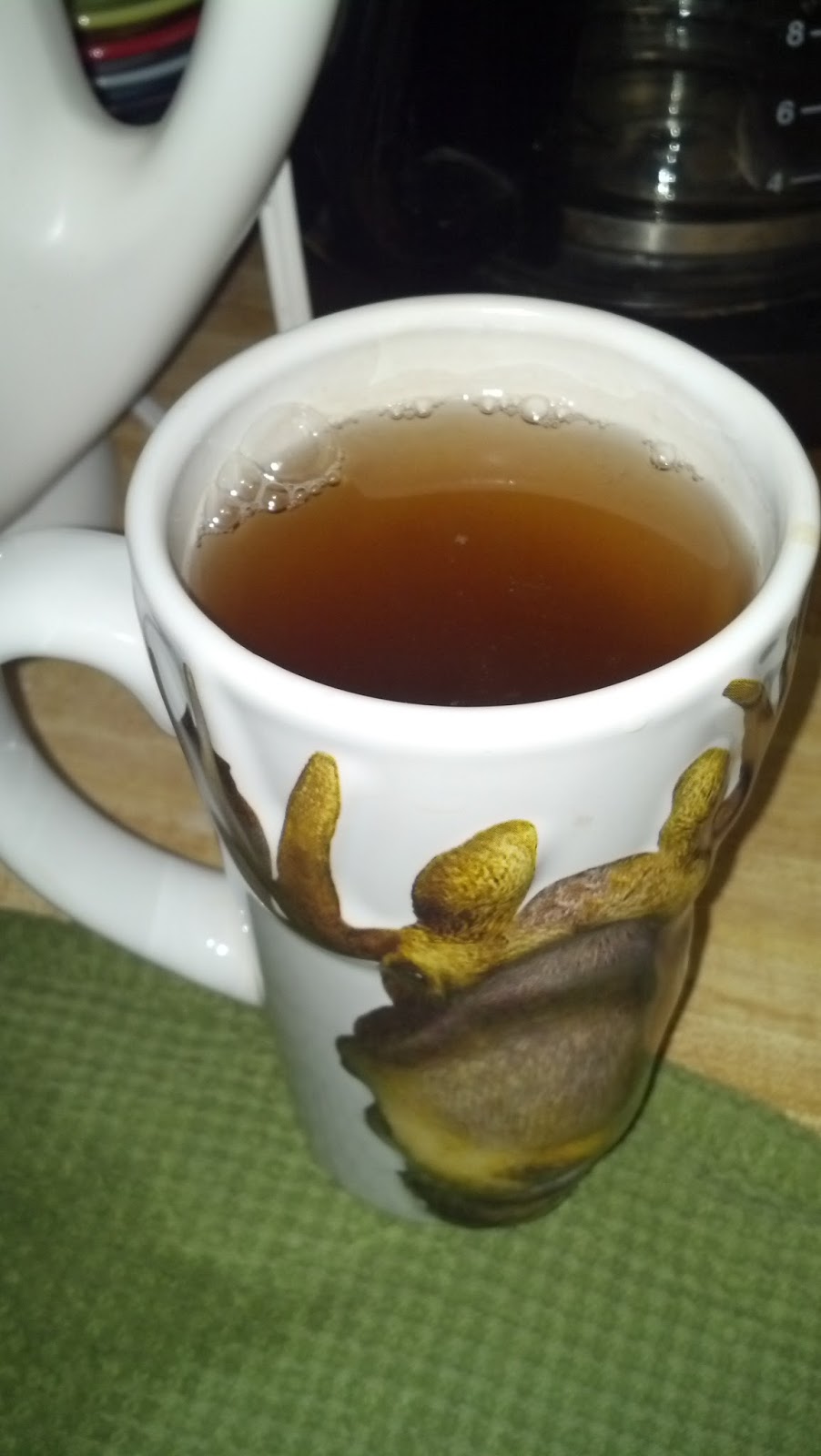
tea from CHINA!!!
It amazes me that you can order things from China and it comes in like a week!!! Boy, have times changed!
Chinese black tea
Yunnan Pu-erh tea
165g,36 pieces
6 taste: rose, Polished glutinous rice, normal, Honeysuckle, Chrysanthemum, Lotus leaf
Wish I could read Chinese, then I would know what flavor I was trying!!
I think this was a "normal" flavor. It was sort of plain, I was a little disappointed in the taste. I think I expected something odd, and it was just sort of plain. Nothing overly exciting. I will try the other colors and see what I think.
Pu-erh or Pu'er tea is a variety of fermented dark tea produced in Yunnan province, China. Fermentation is a tea production style in which the tea leaves undergo microbial fermentation and oxidation after they are dried and rolled. This process is a Chinese specialty and produces tea known as Hei Cha (黑茶), commonly translated as dark, or black tea (this type of tea is completely different from what in West is known as "black tea", which in China is called "red tea"). The most famous variety of this category of tea is Pu-erh from Yunnan Province, named after the trading post for dark tea during imperial China.
Pu'er traditionally begins as a raw product known as "rough"
Mao Cha (毛茶) and can be sold in this form or pressed into a number of shapes and sold as "raw"
Sheng Cha (生茶). Both of these forms then undergo the complex process of gradual fermentation and maturation with time. The Wo Dui process (渥堆) developed in the mid-1970s by the Menghai and Kunming Tea Factories created a new type of pu-erh tea, whose legitimacy is disputed by some traditionalists. This process involves an accelerated fermentation into "ripe"
Shou Cha (熟茶) which is then stored loose or pressed into various shapes. All types of pu-erh can be stored to mature before consumption, which is why it is commonly labelled with year and region of production.
Process and oxidation
Pu'er teas are often collectively classified in Western tea markets as post-fermentation, and in Eastern markets as black teas, but there is general confusion due to improper use of the terms "oxidation" and "fermentation". Typically black tea is termed "fully fermented", which is incorrect as the process used to create black tea is oxidation and does not involve microbial activity. Black teas are fully oxidized, green teas are unoxidized, and Oolong teas are partially oxidized to varying degrees. Yellow tea is oxidized to a minimal degree during sun drying and thus is very similar to how pu-erh begins its very different process.
All Pu-erh teas undergo some oxidation during sun drying and then become either 1) fully fermented with microbes during a processing phase which is largely anaerobic, i.e. without the presence of oxygen. This phase is similar to composting and results in Shu (ripened) Pu-erh, or 2) partly fermented by microbial action, and partly oxidized during the natural aging process resulting in Sheng (raw) Pu-erh. The aging process depends on how the Sheng Pu-erh is stored, which determines the degree of fermentation and oxidization achieved.
According to the production process, four main types of pu'er are commonly available on the market:
- Maocha, green pu'er leaves sold in loose form as the raw material for making pressed pu'er. Badly processed maocha will produce an inferior pu'er.
- Green/raw pu'er, pressed maocha that has not undergone additional processing; high quality green pu'er is highly sought by collectors.
- Ripened/cooked pu'er, pressed maocha that has undergone fermentation in the ripening process for up to a year. Badly fermented maocha will create a muddy tea with fishy and sour flavours indicative of inferior aged pu'er.
- Aged raw pu'er, a tea that has undergone a slow secondary oxidation and a certain degree of microbial fermentation. Although all types of pu'er can be aged, the pressed raw pu'er is typically the most highly regarded, since aged maocha and ripened pu'er both lack a clean and assertive taste.
I also read this interesting article
History of Puer Tea 
The most famous tea from Yunnan is Puer. Yunnan also produces green tea, jasmine tea, and black tea. Yunnan province is in south west China and the origin of tea can be traced there. There are a number of trees in Yunnan that can be dated back more that 2000 years. The rain forests of Yunnan are rich in diversity, a majority of the flowers that we grow in the US can be traced back to Yunnan.
Yunnan began to process tea in the Three Kingdoms period (220-360). Allegedly, at this time Zhu Ge Liang from Sichuan, a clever tactician, encouraged the Yunnan people to cultivate tea to improve their lives. Still, Yunnan people call Zhu Ge Liang their tea god. He is still prayed to in the south of Yunnan where he conquered more that 2000 years ago. This is the area of Xichuanbanna and the six famous mountains. At the heart of Yunnan’s south west is the city of Puer, the base of the province’s ancient tea market, and from where “puer tea” derives its name. (The city Simao in 2007 changed its name to Puer, and should not be confused with the ancient city). From Puer city, tea was distributed to Tibet, and South East Asia on “tea horse trading roads.” The rough terrain of Yunnan demanded efficiently packed tea, so compressed cakes of tea were wrapped and tied into stacks of seven and enclosed into a bamboo shell. For this reason, certain puer cakes are commonly labled “Qi Zi Bing” or literally Seven Piece Cake. Carrying tea though the humid rain forest over the long, hard trading routes may have encouraged natural fermentation.

People collect puer tea for three main reasons, which include enjoyment of the tea, overall health benefits and the investment potential. It became popular outside of the traditional markets of Tibet and Mongolia, where for many years it was exchanged for horses, when it became sought after in Hong Kong for its health benefits, and for its mysterious quality of slow, natural fermentation, that causes it to improve with age. During the Cultural Revolution a lot of the old cakes were destroyed increasing the rareness of aged puer. In 1973, a process was invented to create fermented puer in about 60 days.

All tea originated in Yunnan, but you might be surprised to know that the tea plants are called Camellia Sinesis Assamica. The reason is that when the British found the variety of tea growing in India they named it Assamica and believed that it was wild, but it had actually been planted along the old Silk Road that ran from Yunnan and Burma into Assam. Even though the origin issue has been cleared up, the ancient tea trees in Yunnan have kept the inaccurate name.
A lot of puer produced is said to be made from wild tea trees, but this is not the case. Wild tea trees are known to make people pretty sick sometimes, and what is called “wild” by puer makers is in fact old tea trees that have been cultivated, and are usually over a hundred years old. The age of the tree can be determined by measuring the trunk. Trees have very often been cut back drastically to increase yield, and more bushes are being planted at break neck speed. Planting tea is helpful to the the environment in Yunnan that has suffered from the burning of forests to plant sugar cane. Sugar, though a profitable short term crop, quickly depletes the mountain soil and erosion can quickly wear away the topsoil from whole mountain sides.

Puer is separated into ten grades determined by leaf size, with the largest being tenth grade. In understanding about grades, it is wrong to assume that the 1st grade is the best grade for puer. There is only an incidental correlation between the grade of the puer and the quality of an individual cake. For example, some of the most sought after tea is made from maocha that is larger than tenth grade tea. It is always a question of taste. Of course if a lot of expensive buds are used in a cake, it will drive the price up, even if it is not considered a good candidate for aging. So don’t be strictly guided by the grade, think also about the uniformity and tightness of compression and the overall flavor achieved by the cake’s mao cha blend.
this is from
http://www.sevencups.com/about-tea/puer-tea/


 Black tea Finest quality black tea leaves superbly blended with the bright fruity taste of just-picked currants. A delectable, lush cup with soothingly sweet blackberry undertones, floral notes and a delighting finish.